
Private vs Group Swimming Lessons: Which Is Better?
Private vs Group Swimming Lessons: Which Is Actually Better for Your Child?
If you’re shopping around for swimming lessons, you’ve probably come across both options and wondered whether it’s worth paying more for one-to-one instruction. It’s a fair question — and the answer depends on a few things that most swim schools won’t tell you upfront.
The case for private lessons
One-to-one swimming lessons give your child undivided attention for the full session. There’s no waiting, no competing for the teacher’s eye, and the pace is entirely tailored to your child. For children who are very anxious around water, have specific learning needs, or are working on a particular technique ahead of a competition or test, private lessons can be genuinely valuable.
The downside is cost. Private lessons typically run at three to four times the price of a group session, which adds up quickly over months of weekly attendance. And cost aside, some children actually perform worse in a one-to-one setting — the pressure of having an adult’s full attention with no peers around can feel more intense, not less.
The case for group lessons — and why class size is everything
Group lessons are often dismissed as a budget compromise. But that framing only holds if you’re comparing a 1:1 lesson to a class of 10. Compare it to a class of 4 or 5, and the picture looks very different.
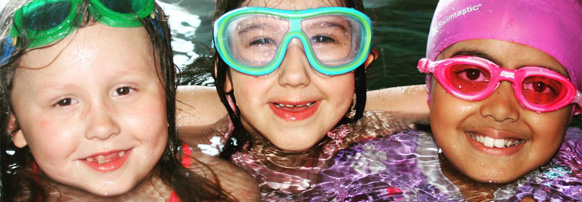
In a well-structured small-group lesson, your child gets consistent teacher attention, regular turns in the water, and the added benefit of learning alongside peers. Watching other children try something new — and seeing them succeed — does something for a child’s confidence that individual instruction often can’t replicate. Swimming is partly a social skill, and learning it with others reinforces that.
A class of 5 also costs significantly less than private tuition. If both are producing similar progress — which the research broadly supports for typically-developing children — the value calculation isn’t close.
Where the comparison breaks down
The group vs private debate assumes the group is well-structured and small enough to deliver real teaching. Many aren’t. Classes of 8, 10, or 12 children are common at large leisure centres, and in those environments, individual progress is slow and attention is thin. If you’ve had a child in lessons for a year with little movement, large class size is often the culprit — not your child.
This is why we’d push back on the framing of ‘private vs group’ and suggest the real question is: how many children are in the group, and how much actual teaching time does your child get per session?
What about nervous swimmers or children with additional needs?
For children who are very anxious or who have additional needs, the standard group vs private comparison doesn’t fully apply. These children often need a specialist teaching approach rather than simply fewer children in the class — though a calm, small group is a good starting point.
At Love to Swim, we run specialist autism-friendly sessions alongside our standard programme. These aren’t just smaller classes — they use structured routines, sensory-aware teaching methods, and teachers with experience in working with neurodiverse swimmers. The demand for these sessions is high, and we currently operate a waiting list.
So which should you choose?
For most children: a well-structured small-group lesson (4 to 5 swimmers) from a quality swim school will deliver equivalent progress to private tuition at a fraction of the cost. Save private lessons for specific situations — a child working through significant water anxiety, a targeted skill to fix, or a child who genuinely struggles in any group setting.
If you’re currently in a large group class and not seeing progress, the answer probably isn’t to switch to private. It’s to find a smaller group.
All our lessons at Love to Swim are capped at 5 swimmers. If you’re based in East London and want to see what that looks like in practice, we’d love to show you.
Contact